
Stair Lift Installation
Stair lift installation is one visit: 2 to 4 hours on a straight staircase, or 4 to 5 hours on curved stairs once the rail is made to fit. Bolts hold the rail to the stair treads, the flat surface of each step, never to the wall.
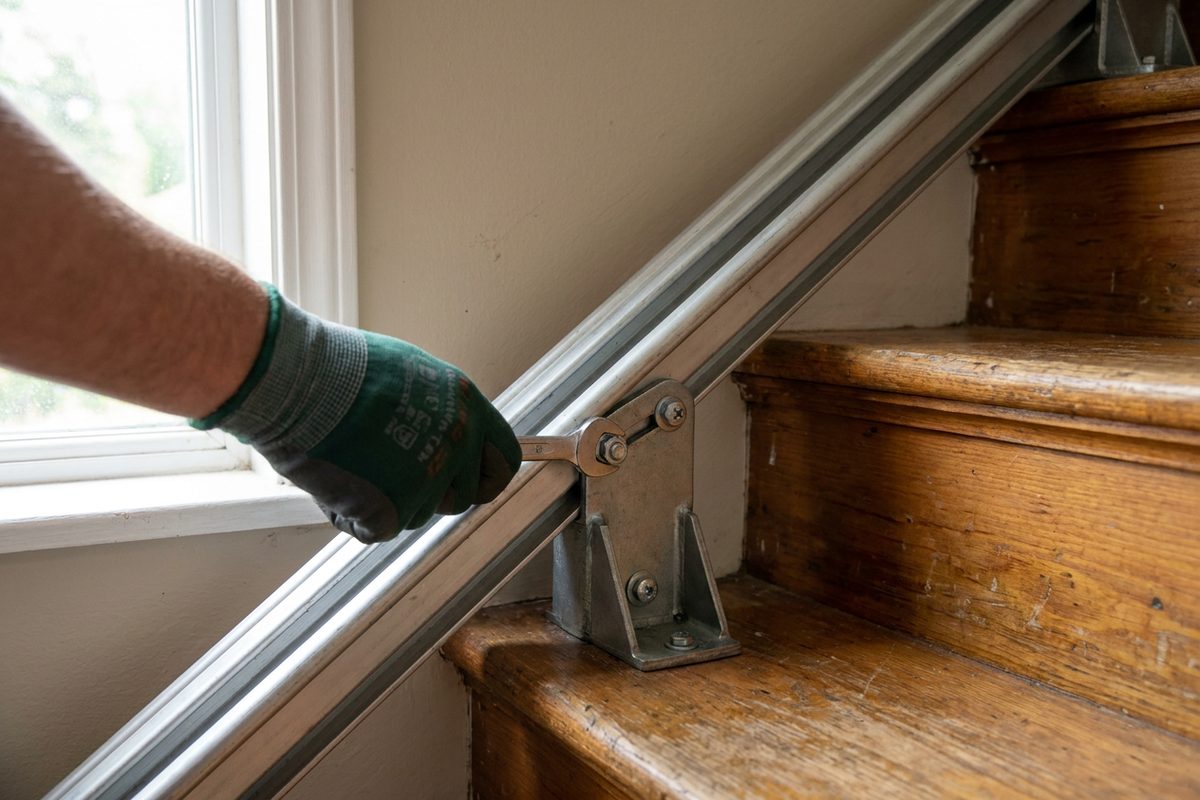
- Fitting a straight lift
- 2 to 4 hours
- Fitting a curved lift
- 4 to 5 hours
- Wait for a curved rail
- 3 to 5 weeks made to measure after the survey
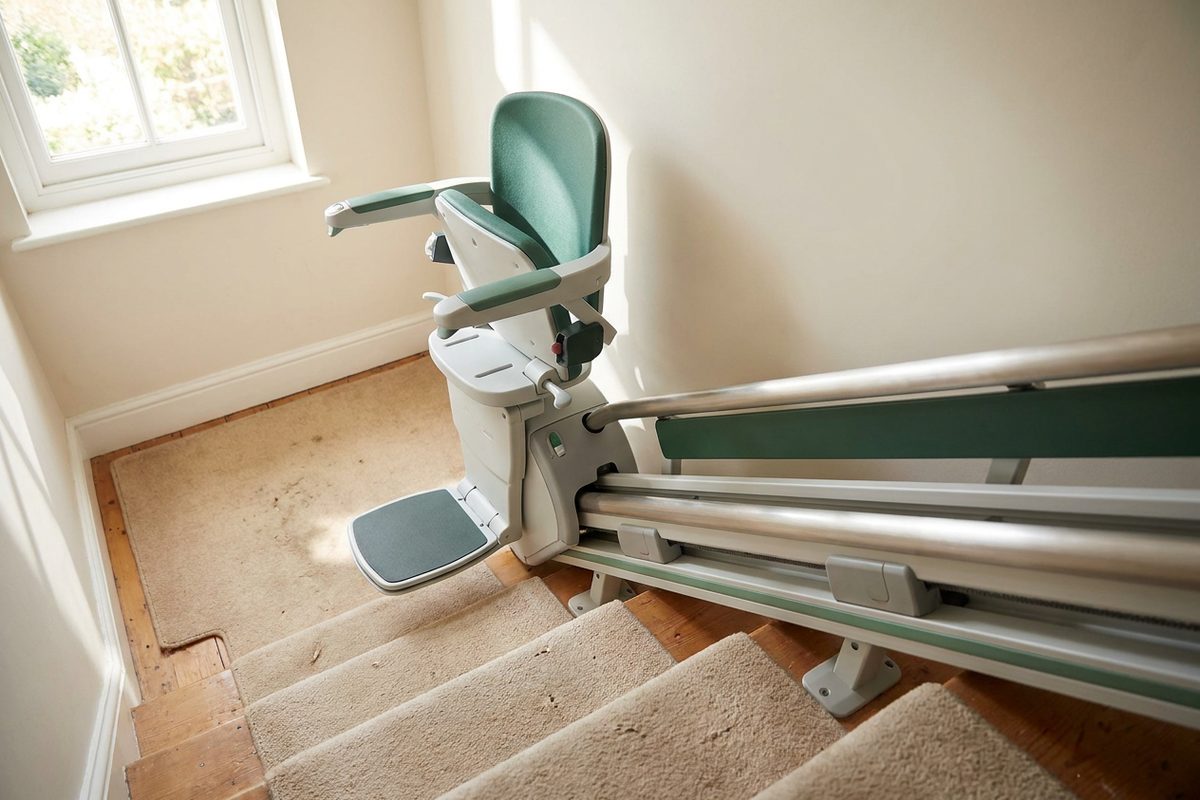
- Straight lift, installed
- $2,500 to $7,500 curved and outdoor on the cost page
Stair Lift Installation in Four Steps
Home survey
An installer measures the stairs, checks the power outlet and notes landings or turns. Many dealers make this visit free.
Order
A straight rail is cut from stock; a curved rail is made for your stairs, which takes about 3 to 5 weeks.
Fitting day
The rail is bolted to the steps, not the wall: 2 to 4 hours for a straight lift, 4 to 5 hours for a curved one.
Learning the controls
The installer rides the lift with you, shows each control and explains the service plan.
Prepare Your Home for Stair Lift Installation
- Clear the stairs and landingsInstallers need clear steps to fix the rail brackets safely.
- Give the team access to the stairs and outletThe crew works at the staircase and the power outlet.
- Keep a parking spot for the vanThe crew brings the rail, chair and tools in a van.
- Keep pets and children away from the work areaTools and open parts are on the stairs until testing ends.
- Plan to be home for the demonstrationThe person using the lift should try it with the installer before they leave.
- Expect a few screw holes in the stepsBrackets are screwed to some steps, and the holes stay if the lift comes out.
Power
- Check there is a power outlet near the top or bottomBattery lifts charge from a wall outlet while parked.
- Book an electrician if there is no outlet nearbyNo outlet near the stairs means one must be added first.
Questions to Ask at the Survey
- What warranties are included?Cover for the lift, parts, battery and fitting work can each differ.
- Who handles warranty claims and service?The installing dealer is usually your repair contact.
- Do you use your own installers?Their own staff, rather than outside fitters they hire, can make later service easier.
- What does a service call cost?Repair response time matters if the lift stops.
- How quickly do you respond to repairs?If the lift stops, the person using it can be stuck on one floor until it is fixed.
- Is a permit needed and is it in the quote?Some states and towns require a permit and inspection.
- Does the quote include everything?Delivery, fitting, permits and taxes can be extra.
- Can you remove it, move it or buy it back later?Some manufacturers do not buy back used lifts.
What Your Stairs Need
- Stair width
- About 28 in straight lift; about 30 in for curved (Stannah)
- Power outlet
- Within 10 ft of the top of the rail (Harmar)
- Power cut
- Battery lifts run up to 60 trips on a Harmar SL600
- Permit
- Some states require one, so ask for it in the quote
Choosing an Installer
Most buyers get their lift from a local dealer who also fits it. Bruno works only through factory-trained dealers who handle both sales and fitting, while Harmar strongly recommends professional installation.
Our directory covers 967 installers in all 50 states. Of those, 686 sell Bruno lifts, 450 sell Harmar and 169 sell both, though selling a brand does not mean a dealer has that lift in stock. Repairs and servicing are listed by 636 of them, which is worth knowing since the dealer who installs your lift is often the one who maintains it down the line.
We build our listings from the public dealer lists published by Bruno and Harmar, and we update them every three months. Searching by ZIP code brings up installers with an office within 40 miles, ordered by distance. When fewer than 3 come up, the search widens to 80 miles, then adds Bruno dealers who report covering that area.
Power and Space
The rail is screwed to the stair treads, not the wall, with a handful of screws in each rail foot.
Most lifts run on a battery that charges while the chair is parked, so they keep working in a power cut: a Harmar SL600 manages up to 60 trips. Some models, such as the Harmar SL350AC, run straight off household power.
Either way, you need a standard three-prong wall outlet near one end of the stairs. Harmar installers look for one within 10 ft of the top of the rail; if there is none, an electrician fits one before fitting day.
A straight lift needs stairs about 28 inches wide and a curved one about 30 inches, measured from the handrail or whatever sticks out most.
Sources: Stannah stairlift requirements, Bruno, Harmar SL600 and the Harmar installation guide.
How Long Does It Take?
The fitting itself takes a few hours. How long you wait before it depends mostly on whether your stairs are straight or curved. Each range is the middle of the figures manufacturers and price guides publish.
| Staircase | Hours on site | Wait between ordering and fitting |
|---|---|---|
| Straight | 2 to 4 hours | 1 to 15 days |
| Curved | 4 to 5 hours | About 3 to 5 weeks |
Dealers often keep straight indoor lifts in stock, and Stannah says it can fit one within 5 working days. A curved rail is made after the survey: Stannah allows 3 to 4 weeks, ConsumerAffairs 4 to 6. Acorn builds its FastTrack rail at your home and offers next-day fitting in some areas, even on curved stairs. A curved Harmar fitting takes a team of 2 to 3 people.
Sources: Stannah, ConsumerAffairs, Acorn and Harmar.
Will It Damage My Stairs?
Very little. Stannah fits over carpet and hardwood without lifting the carpet or boards, and handrails can stay where they are or be moved.
If the lift comes out later, the treads keep a few small screw holes. Bruno says they do not show on carpet; on bare wood, concrete or metal you will see them.
Do You Need a Permit?
It depends on where you live. Bruno notes that some states require permits, and some states and towns inspect stair lifts even in private homes. Ask the installer to put any permit and inspection fees in the quote.
Most of these rules point to ASME A18.1, the US safety standard for stairway chairlifts. Four examples:
- Georgia: home stairway chairlifts need a permit and stamped drawings, and are fitted and tested to ASME A18.1.
- Illinois: stairway chairlifts are registered with the state, but single-family homes do not need to register.
- Minnesota: inspectors check each chairlift against a permit number and an ASME A18.1 checklist.
- Connecticut: the people who fit home stair lifts are licensed as technicians.
Very steep stairs may need sign-off too: Harmar says stairs steeper than 45 degrees may need local approval.
Who Does the Fitting?
- Installers listed
- 967 in 50 states
- Carry Bruno
- 686
- Carry Harmar
- 450
- List repairs and service
- 636
Bruno and Harmar lifts are fitted by the manufacturer's authorized dealers. Each row on our stair lift installer list links that dealer's own Bruno or Harmar listing, so you can check the authorization with the manufacturer. Acorn sends its own fitters, and Stannah its own technicians or a distributor. Pick your brand to see who fits it:
A new straight lift usually costs $2,500 to $7,500 installed. Bought one used or online? Fitting it usually costs $550 to $850: see used and online lifts. Every range is on the installed cost page.
A Lift You Already Own, Outdoor Steps and Removal
- Bought a lift used or onlineFitting a straight one usually costs $550 to $850. Often a straight rail can be cut down to fit a new staircase, but a curved rail gets bent to match one particular set of stairs and rarely fits a different one. See used and online stair lifts.
- Outdoor stepsOutdoor lifts are built for rain and sun, and typically cost $2,000 to $3,500 more than indoor ones. See the installed cost table.
- Taking a lift outRemoval usually costs about $100 to $300, and a straight lift can often go with you when you move. Servicing and faults are on the stair lift repair page.
Published Figures for Named Models
Three numbers decide whether a model suits your stairs: the weight it carries, the stair angle it is built for, and how far it sticks out when folded.
| Model | Weight limit | Stair angle | Folded size |
|---|---|---|---|
 Bruno Elan | 300 lb | Not published | Not published |
| Bruno Elite Straight Indoor | 400 lb | Not published | Not published |
 Harmar Pinnacle SL600 | 350 lb | 27-52 degrees (above 45 may need local approval) | 10.5 in folded from wall |
| Harmar Pinnacle SL600HD | 600 lb | Not published | Not published |
 Acorn 130 | 280 lb (HD version 350 lb per acorn-stairlifts.com) | 29-55 degrees | 12.25 in folded |
 Stannah Siena | 350 lb straight / 352 lb curved | Not published | 14.5 in straight / 16 in curved |
 Handicare 1100 | 310 lb (287 lb above 46 degrees) | 30-50 degrees | 12 5/8 in (320 mm) |
Your installer confirms each figure for your stairs at the survey. Costs are on the installed cost table.
Ready for a survey? Call and we pass your stairs to installers who work near you.
Call (888) 314-9397Common Questions
What does it cost to have a stair lift installed?
A new lift's price often includes fitting. Bruno notes that the dealer sets the fitting price and often includes it. Each range below reflects the middle of figures published by three or more independent price guides, manufacturers or dealers. Treat them as a rough guide, not as quotes.
| Lift type | New lift, price installed |
|---|---|
| Straight staircase | $2,500 to $7,500 |
| Curved staircase | $9,000 to $15,000 |
| Two straight flights joined by a landing | $9,000 to $15,000 |
| Straight, outdoor | $4,000 to $10,500 |
| Curved, outdoor | $10,000 to $20,500 |
Standard straight rails run 15.5 ft long. Every additional foot of rail costs roughly $80 to $100 more. Bruno, as one manufacturer example, starts its straight lifts at about $4,000 and its curved lifts at about $13,000.
Can I fit a stairlift myself?
Harmar strongly recommends professional installation, and Bruno sells and installs its lifts only through factory-trained dealers. If you picked up a straight lift secondhand or online, professional fitting usually runs $550 to $850.
Does Medicare cover stair lifts?
No. Stannah says that Medicare does not cover stairlifts.
We don't sell, fit or repair lifts, but installers may pay us for introductions.